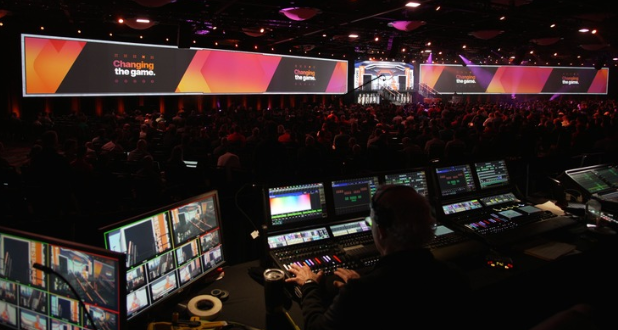
Pure Storage gave Stagevision an unusual brief for a corporate sales kickoff: make it feel like a sporting event, without making it feel American. The company’s 2025 SKO, held over seven days at Walt Disney World’s Swan and Dolphin Resort, needed to energize a genuinely global sales force spanning the Americas, EMEA, and APJ, and the client’s mandate was specific: professional broadcast graphics, a sports-desk host, dynamic camera pickups through the crowd, all in service of making every attendee feel less like they were sitting through a sales meeting and more like they were suiting up for a championship season.
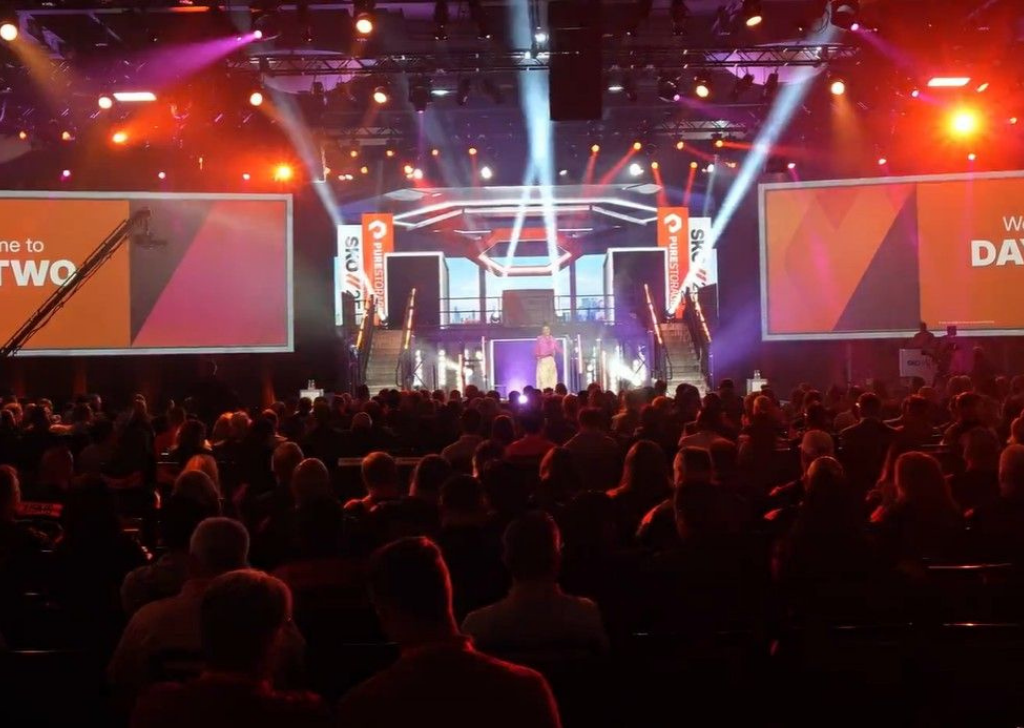
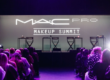
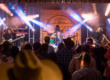
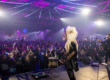
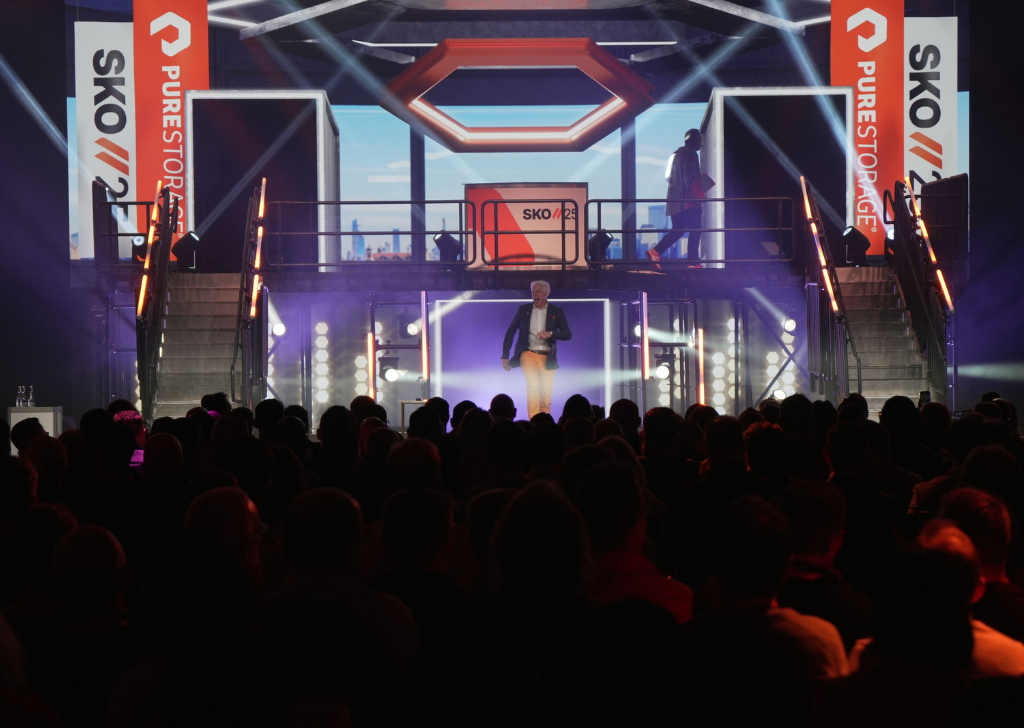
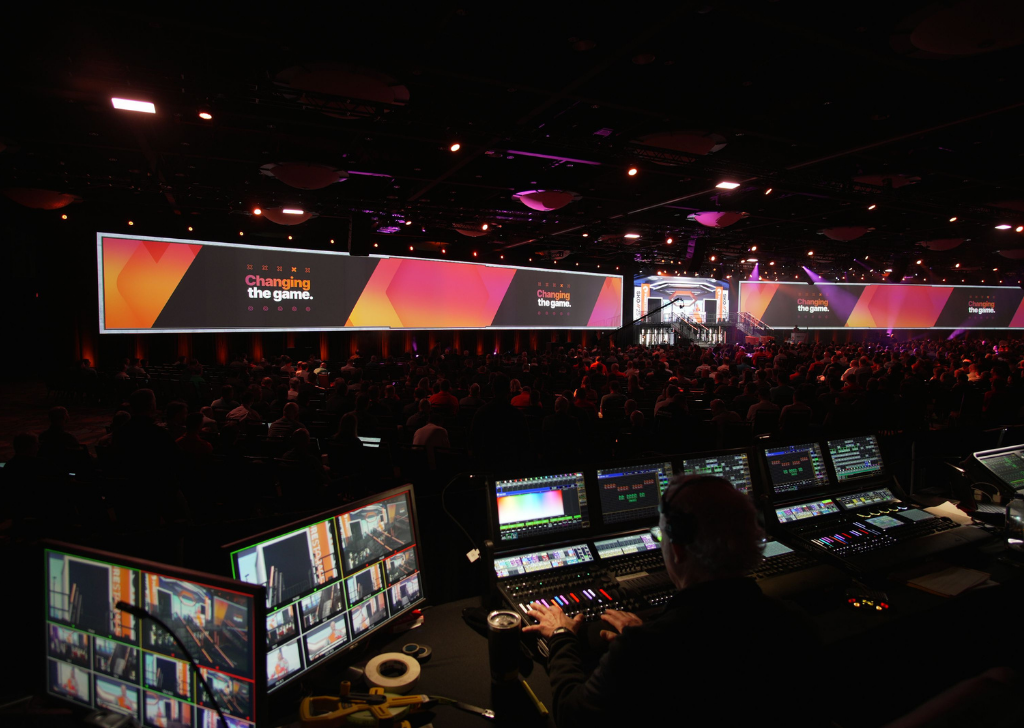
Stagevision’s answer was to rebuild the resort’s 40,000-square-foot Pacific Ballroom as an actual broadcast center. A two-tier main stage — a 1,200-square-foot primary platform beneath a 500-square-foot upper deck — gave the production separate entrances for presenters, a dedicated perch for the sports-desk host, and room for reveal moments that a single flat stage couldn’t have delivered, all connected to backstage by a custom ramp built specifically to let presenters walk out through arena-style tunnel entrances. Flanking the stage, two 120-foot LED walls were built to read as stadium outfield banners; look closer and what seemed like static signage was actually slow-moving video content, keeping the room subliminally alive even during a static keynote. Twelve Christie 4K25 projectors mapped forced-perspective content onto raised structures, curved desks, and pedestals, creating real spatial depth in what was, physically, still a flat hotel ballroom — a technique borrowed more from film production than from corporate AV.
None of that visual ambition came at the cost of reliability, which is the harder half of the brief in a show this size. Three fully independent production teams, general session, ten-plus breakout rooms split across Northern and Southern Hemisphere halls, and a secondary set of sessions in the Swan building, ran in parallel across the resort, each with its own crew, equipment, and troubleshooting capacity, sharing only power infrastructure and RF spectrum. Getting there took more than 470 hours of pre-production. Power alone was segmented into dedicated 400-amp and 200-amp distribution for general session AV and the LED wall respectively, while a Dejero cellular gateway gave the broadcast a path independent of venue WiFi entirely.
It’s that combination, genuine broadcast-calibre creative ambition matched by redundancy engineered into nearly every system, that earned Stagevision this year’s Canadian Event Award for Best Technical Production Support. The real test came mid-show, when a Google Slides compatibility issue surfaced live, incompatible with the broadcast pipeline’s expected format. The crew reworked the media server and vMix workflow in real time, with no visible disruption to the program and no delay to the schedule — the kind of fix that either works invisibly or becomes the story of the show, and here, nobody in the room ever noticed it happened.
Across seven continuous production days and three simultaneous venues, the show ran with zero critical failures.
Photography credit: Bryce Engelman, Stagevision.
To learn more about Stage Vision, visit their website and social media pages.


Pure Storage gave Stagevision an unusual brief for a corporate sales kickoff: make it feel like a sporting event, without making it feel American. The company’s 2025 SKO, held over seven days at Walt Disney World’s Swan and Dolphin Resort, needed to energize a genuinely global sales force spanning the Americas, EMEA, and APJ, and the client’s mandate was specific: professional broadcast graphics, a sports-desk host, dynamic camera pickups through the crowd, all in service of making every attendee feel less like they were sitting through a sales meeting and more like they were suiting up for a championship season.
Stagevision’s answer was to rebuild the resort’s 40,000-square-foot Pacific Ballroom as an actual broadcast center. A two-tier main stage — a 1,200-square-foot primary platform beneath a 500-square-foot upper deck — gave the production separate entrances for presenters, a dedicated perch for the sports-desk host, and room for reveal moments that a single flat stage couldn’t have delivered, all connected to backstage by a custom ramp built specifically to let presenters walk out through arena-style tunnel entrances. Flanking the stage, two 120-foot LED walls were built to read as stadium outfield banners; look closer and what seemed like static signage was actually slow-moving video content, keeping the room subliminally alive even during a static keynote. Twelve Christie 4K25 projectors mapped forced-perspective content onto raised structures, curved desks, and pedestals, creating real spatial depth in what was, physically, still a flat hotel ballroom — a technique borrowed more from film production than from corporate AV.
None of that visual ambition came at the cost of reliability, which is the harder half of the brief in a show this size. Three fully independent production teams, general session, ten-plus breakout rooms split across Northern and Southern Hemisphere halls, and a secondary set of sessions in the Swan building, ran in parallel across the resort, each with its own crew, equipment, and troubleshooting capacity, sharing only power infrastructure and RF spectrum. Getting there took more than 470 hours of pre-production. Power alone was segmented into dedicated 400-amp and 200-amp distribution for general session AV and the LED wall respectively, while a Dejero cellular gateway gave the broadcast a path independent of venue WiFi entirely.
It’s that combination, genuine broadcast-calibre creative ambition matched by redundancy engineered into nearly every system, that earned Stagevision this year’s Canadian Event Award for Best Technical Production Support. The real test came mid-show, when a Google Slides compatibility issue surfaced live, incompatible with the broadcast pipeline’s expected format. The crew reworked the media server and vMix workflow in real time, with no visible disruption to the program and no delay to the schedule — the kind of fix that either works invisibly or becomes the story of the show, and here, nobody in the room ever noticed it happened.
Across seven continuous production days and three simultaneous venues, the show ran with zero critical failures.
Photography credit: Bryce Engelman, Stagevision.
To learn more about Stage Vision, visit their website and social media pages.